Monday, April 23, 2007

White Noise

I finally finished my first Don Delillo novel! I say finished, instead of read, because I've picked up most of his novels at least once, so I've read plenty of his novels, but I never seem to finish them. White Noise I had picked up at least twice before I was finally able to get all the way through. That said, I am aware that most of you have strong feelings about White Noise, strong positive feelings, so I want to clarify that this isn't a book bash. I am going to blame my unlove on a few things and well see if we can meet in the middle somewhere.

1. I'm told old, I don't have that dreamy college student thing going for me anymore. Point being, it just not as easy to get wrapped up in the world of White Noise, or the fame that DeLillo has.
2. Americana Literature: in general I find it "obvious". Please don't shoot! Maybe it's that it so NOT obvious I can't even being to grasp it.
3. Too many years of too much hype. Lets face it, people have been talking about how great White Noise (and Delillo in general) is for so long that it would just be impossible for me to find it as great as the build up.

So here's the thing, I didn't hate White Noise, but I definitely didn't love it. There were parts that were rather humors and I did actually laugh out loud on the train (you can imagine how embarrassing that is) and of course the writing is obviously the product of someone who is very talented.

That's not enough to make you love a book though. I was left wondering what the point was. Maybe it's that Delillo is trying to make us really look at our American way and all our White Noise, well I get that, I mean I am actually a part of this society, but then what? What does he want us to do besides admit we are so distracted we don't even know ourselves? This is how I usually feel about Americana lit (see point 2)(not that I have read a ton of it.) I spend 300 or so pages with your book but its all just to point out the obvious. I don't need a book to be reminded that I spend 9 hours a day on a computer, I read books to get away from that.

As contrived as the ending was, I did kind of like it, but it came long after I assumed there would be nothing redemptive about Jack's character. I am sure someone wants to fight me on that comment, and I wholly welcome it, please tell me why I'm so so wrong. And what does Wilder's tricycle ride across the interstate signify?

Thursday, April 19, 2007

Erik Larson in the White City Tonight.

For those of you who live in Chicago, Erik Larson will be sharing anecdotes and 'war stories' derived from his books Devil in the White City and Thunderstruck tonight at the Crown Auditorium Theater. Admission is free and it should be a good time. Personally, I found Devil in the White City to be one of the more gripping stories I have read in the past few years. His writing brings alive that feeling of excitement that surly came with building a new city--making you feel like you just stumbled across some previously inconceivable technology. While at the same time being let in on the twisted events of one of the country's scariest mass murderers. The best part about it, it's non-fiction. And if you are fortunate enough to live in the White City while reading it, you can spend your lunch breaks looking for old Daniel Burnham buildings--and you probably aren't alone.

And speaking of going to readings, I am wondering what authors all our Luminous readers have been fortunate (or unfortunate) enough to have heard speak. I have not been to too many readings myself but I think Dave Eggars (the first time) is still my favorite.

UPDATE: For a man who has proven himself to be a master in writing about murders Erik Larson was surprisingly (and welcoming) socially adept, not to mention very funny and horrifyingly intelligent albeit not in that cocky way some people are. I had a great time, and no, not just because he called George Bush, Julius Ceaser.

Tuesday, April 17, 2007

Cormac McCarthy wins Pulitzer


The 2007 Pulitzer prizes were anounced, and the winner for fiction is The Road, by Cormac McCarthy. I am surprised to see our beloved WH has not posted upon this over at pandas, but seeing as he has gone AWOL from the blogosphere, here it is.
From what I understand The Road is a dark, violent book, scathing at times, horrible, yet you know hopeful (some say). For example, here is a quote lifted from the review by Publisher's Weekly: "Beyond the ever-present possibility of starvation lies the threat of roving bands of cannibalistic thugs." I guess it only seems appropriate to see The Road end up on Oprah's Book List, then. If you have read The Road and want to discuss the deeper messages McCarthy finds within this dark and troubling story, please direct your comments here.


Here is a complete list of the Pulitzer Winners. (I had my money on Debbie Cenziper from the Miami Herald to win best local reporting. It was Debbie's year).

Monday, April 16, 2007

The Devil and The Angels


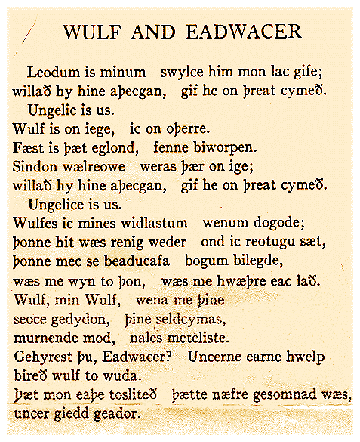
Emak and I are taking a class this time around entitled Angels and Devils in Medieval Literature. It's pretty awesome, if you like reading Anglo-Saxon poems in prose translations (which everyone knows is not the way to read them, but do you know Anglo-Saxon?)
Our texts include the aptly named LUCIFER, ANGLO-SAXON POETRY, the wonderful VISIONS OF HEAVEN AND HELL BEFORE DANTE, and of course, DANTE.
Medieval representations of the devil are pretty damn awesome. It's not like that's news or something, but it's still worth noting. I've become a pretty big fan of the Harrowing of Hell as a theological precept from the day. It allows for me to get Judas into heaven without having to committ any grave acts of heresy. Except for maybe getting Judas to heaven. Just read the Gospel of Nicodemus.

Thursday, April 12, 2007

Kurt Vonnegut, book writer, humorist, dies

I learned my lesson last time I mentioned the death of a certain philosopher to use no wit or humor when reporting these stories. So this time, I will just link to the story from the Old Grey Lady about the death of Kurt Vonnegut. He was 84.
Here's a wonderful little note from the Times about the same author who wrote Slaughter House Five. "To Mr. Vonnegut, the only possible redemption for the madness and apparent meaninglessness of existence was human kindness." Or, as Mr. Rosewater puts it in God Bless you Mr. Rosewater, "God-damn it, you've got to be kind."


So. Mr. Vonnegut, adieu.
I found this picture on Google. It seemed appropriate.

Kurt Vonnegut Dies


Kurt Vonnegut died last night in Manhattan at the age of 84. According to the New York Times, his wife, Jill Krementz, said that after a fall several weeks ago, the author had suffered brain injuries. Born in 1922, Vonnegut was the youngest of three children and lived through the Depression, his mother's suicide, and being captured as a prisoner of war during World War II. His famous book, Slaughterhouse-Five, is based on his experience during the war. After the war, Vonnegut worked as a newspaper reporter and studied at the University of Chicago before his first book, Player Piano, was published in 1952. Vonnegut, who wrote fiction, plays and essays, is known for his 14 novels including Slaughterhouse-Five, Cat's Cradle and God Bless You, Mr. Rosewater.

Monday, April 02, 2007

HIP! HIP!

CZFinke took his MA Comprehensive Exam on Saturday, there was lots of reading and studying that went into the test over the last five months!! And lots of partying when it was over! Lets all give him a big pat on the back...blogger style!

Wednesday, March 28, 2007

In case you haven't already read

The Road by Cormac McCarthy, now is your chance. Oprah has made it her most recent book club pick. Dear oh dear she annoys the crap out of me...

And if you live in Chicago (or Illinois in general) the new One Book, One Chicago pick has been selected: Go Tell It On The Mountain by James Baldwin. I haven't previously participated in One Book, One Chicago-- but I plan to this time around and I am awfully excited about it. It has proven in the past to be a great way to unite our large and diverse city AND Chicago (i.e. Daley) sponsors all sorts of great (AND FREE) lectures and films surrounding the book pick. (Truth be told, I don't think anyone in Chicago reads this blog--so mostly I am writing to express how excited I am to read this book.)


And another book club option , which can have a bit of action via luminous if you are so interested, White Noise by Don DeLillo. I am reading the book here in my home city with a few other friends who also haven't read it yet, I think we are the last people alive to have not read it, which leaves me hoping many of you will have all sorts of opinions about it.

Sunday, March 25, 2007

Tolkien Jr. finishes Tolkien Sr.'s final Lord of the Rings book


Children of Hurin, the last book J.R.R. Tolkien began in the Lord of the Rings series, in 1971, has been finished and will be published next month. What? I don't know anything about Christopher Tolkien, but could the stakes be any higher? Is there a more beloved series than Lord of the Rings?

Here's another story from the old grey lady about Tolkien fans and Children of Hurin.

Saturday, March 24, 2007

Stanley Cavell and the end of the exam series

As the 7 people who stop in at Luminous know, I have been studying for my comprehnsive exam for my masters. Now, it's down to the wire, 7 more days to study and read from those wonderful texts I can nearly recite backwards. "wife a of want in be must, forutne good a of possession in man single a that, acknowledged universally truth a is It." See.
Anyway. I've been reading (over and over) Stanley Cavell's chapter on It Happened One Night from Pursuits of Happiness. He's pretty smart. I'm in to posting pictures of these scholars and philosophers. It makes a litte impression on me when I've been reading these people, and eventually to come around and take a look. They are usually older, white, often bespectacled, balding. Stanley here appears to be clutching his chest, which is never a good sign. Just hacking on you Professor Cavell. Love your work.


This isn't that interesting. Well it's a bit interesting to me.

Tuesday, March 20, 2007

The Year of Magical Thinking

I picked up Joan Didion's most recent work this past weekend, The Year of Magical Thinking, and basically plowed through it. I found the book very moving and comforting, but how could you not? Its so personal and about such a difficult subject. I suppose the big shocker for me was that someone could have the ability to give others such a detailed inside look at their grief. In this case, it seems very self sacrificing--I suppose I think that because so many of the people who will pick it will be doing so because they need something to relate to, but personally I just don't know how she did it.

Here is an interview with Didion if you are interested.

Sunday, March 18, 2007

Some books about books...

It took me a while to get through Matthew Battle's book, The Library: An Unquiet History, but once I finally picked it back up I breezed through it and learned all sorts of interesting new stuff about the Library: from the burning of the Library at Alexandria, to Swift's arguing the Ancients over the Moderns, to just how crazy and backwards the genius of Dewy was. Each chapter had an over arching time frame it focused on and within the chapter a more specific event of that period meant to bring the reader in. Personally I would have been fine with out the fifty pages that focused on Swift (but maybe that's because of the aversion I have had towards him since college) which also happened to the part of the book that stopped me up for two moths, but I think some of you would really enjoy that part (namely, my husband). In short, if you find yourself in awe when you go into the library and would like to learn a bit more about it's history this book is a good place to start.

I found myself totally engrossed in Maureen Corrigan's book, Leave Me Alone, I'm Reading-so much so that I felt disgruntled existing in any world other than hers. I highly recommend picking it up if you are an avid reader, she not only gives you an amazing book list to look into but she also discusses so many great and new ideas that are fun to ponder. I particularly loved her idea of the "female extreme adventure novel" in which she argues that female characters, more often than we recognize, have extreme --life suspending--adventures that get passed over because they don't speak to that outward notion of adventure we have become so used to. She also discussed the "honorary male" or "learned androgyny" status women adhere to to be taken seriously in the world of reading--both in real life and in stories, an issue I struggle with in my life and therefore found very eye opening. If there is one book you should pick because of this blog, this is the book. It's wonderful.

Thursday, March 15, 2007

Fun with Norton Critical Editions.

As I continue to study for my comps, I get to read all kind of randomness published in the back of Norton Critical Editions. After readingthe Norton Importance of Being Earnest cover to cover, I am now reading through the Pride and Prejudice. Let me tell you, there is a wealth wonderful oddities and fun in there.
Here are two of the pleasures that I read.
The first is from some early Austen writing, called Love and Friendship. It is a dialogue about someone knocking on a door.

"My father started--"What noise is that," (said he.) "It sounds like a loud rapping at the Door"--(replied Mother.) "it does indeed." (cried I.) "I am of your opinion; (said my father) it certainly does appear to proceed from some uncommon violence exerted against our unoffending door." "Yes (exclaimed I) I cannot help thinking it must be somebody who knocks for admittance."

Seriously. This continues for about a page or so. Dizzyingly circular discussion about how they all agree someone is knocking on the door, and that whoever it is wants to come in. It's wonderous how it goes on and on.
The other fun thing has less to do with Austen. It comes from a critic named Richard Whately, who wrote an essay called "Modern Novels," published in Qarterly Review 24, in 1821. He's talking about how well Austen handles her Christianity by just not talking about it. I must say I was a tad surprised and comforted to read his great reasoning.

"For when the purpose of inculcating a religious principle is made too palpably prominent, many readers, if they do not throw aside the book with disgust, are apt to fortify themselves with that respectful kind of apathy with which they undergo a regular sermon, and prepare themselves as they do to swallow down a dose of medicine, endeavouring to get it down in large gulps, without tasting it more than is necessary."

Isn't that lovely. I think so. For kicks, Whately ends his essay with, "We know not whether Austen ever had access to the precepts of Aristotle; but there are few, if any, writers of fiction who have illustrated them more successfully." I couldn't agree more. There are few, if any, novels I know of that are more perfectly crafted and and exectued as Pride and Prejudice. I love it.

Tuesday, March 13, 2007

Speaking of taking an hour...

I picked up O Pioneers! this past weekend as part of goal I set for myself, which is currently (not so cleverly) called Ten in Ten. Over the remaining ten months of 2007 I plan to read ten books I have had on my shelves for over a year- in addition to my normal reading. The first of which was O Pioneers! Needless to say, I am pretty excited about this. I have more books than I would like to admit that have been collecting dust for sometime now-and this is a fun way to pick up those books I have always wanted to have read but never really felt like reading. As for my reaction to O Pioneers!--well to begin with there is an exclamation mark in the title and that is just awesome. I think of this book as high school reading, and by that I mean, it is often required that highschooler's read it. Which is a damn shame. If I had read it in high school I know I would not have appreciated it at all, instead I am sure I would have found it boring and pointless. As it is, I have been out of high school for quite sometime, and I have to admit: I loved it! The characters, the long crafted speeches about the land, the heartbreak, I felt as though I was allowed in to this part of history that was formerly not open to me...and now I have some sense of how people lived and thought in the early 20th century. I should say, at no point did I feel I could empathize with the characters but Cather's prose really brought the time period alive. And for that, I am thankful. Not to mention, its so short there really isn't anytime to not like it.

As for the remaining 9 in 10, I plan to read:
Heart of the Matter
All the Pretty Horses
My Antonia
Big Rock Candy Mountain
White Noise
The Street Of Crocodiles
The Sea, The Sea
A Handful of Dust
& Cold Mountain

Monday, March 12, 2007

breaking news: Importance of Being Earnest, Wilde, Funny

I've been pouring over Importance of Being Earnest, one of the texts on my comp exam. It is so damn funny. I know we all know that, but man, it's awesome.
For example:

If I am occasionally over-dressed, I make up for it by being immensely over-educated.

Algy: The truth is rarely pure, and never simple. Modern life would be very tedious if it were, and Modern Literature a complete impossibility.
Jack: That wouldn't be at all a bad thing.
Algy: Literary Criticism is not your forte, my dear fellow. Don't try it. You should leave that to people who havne't been at university.

It goes on and on. I just wanted to remind everyone. Take an hour and read it, it's good stuff.

Saturday, March 10, 2007

Baudrillard: "Rest in...simulated secondary access to post mortem Peace" ?

Jean Baudrillard has died. Our favorite Hyperrealist was 77. His life was spent detmerining that there was no reality to try to tap in to so you're better off not trying, or something.
During his life he wrote more than 50 books, denied that the first Gulf War took place anywhere outside the media, claimed that the current Iraq was is an attempt by America to "put the rest of the world into simulation, and most importantly, inspired, if you call it that, the Matrix, to which he said that the references to his work "stemmed mostly from misunderstandings." Sorry Larry and Andy. You just don't get it.

Here's a "picture" of what Baudrillard "looked like."

Monday, March 05, 2007

Author Identification:

Last fall when I was seeking employment I happened to apply at this little independent bookstore in my neighborhood that specifically caters itself to Women and Children. After bringing in my application and resume they asked me to sit down for a short test that they require all potential employees to take. When they explained the test to me I was pretty excited but that excitement quickly turned to shock and resignation as I realized I didn't know as much as I thought I had. Well, this weekend, I happened to stop back in the store as for a copy and now I present it to you. Below is a list of female authors and the rules are simple: 1. Name a book written by the following authors. 2. No cheating, you are on the honor system. 3. Add up the number you know and post. And for those of you that are curious, I knew books by all of 12 of these authors, not so hot!

Toni Morrison

Mary Oliver

Sandra Cisneros

Sara Partesky

Octavia Butler

Ana Castillo

bell hooks

Jeanette Winterson

Lillian Faderman

Baraba Kingsolver

Margaret Atwood

Rebecca Walker

Gloria Steinem

Anne Lamott

Sarah Schulman

Leslie Feinberg

Gerda Lerner

Gish Jen

Amy Tan

Penelope Leach

Kathleen Norris

Mary Karr

Ursula LeGuin

Terry Tempest Williams

Audre Lorde

Zadie Smith

Jhumpa Lahiri

Alice Munro

Martha Nussbaum

Jane Hamilton

Annie Proulx

Susan Faludi

Adrienne Rich

Thursday, March 01, 2007

What'cha Reading Now?

I am reading Les Miserabls, and I have to admit, most of this book is more boring than any other book I have ever read. But I am only 150 pages in, so I have my fingers crossed.

Saturday, February 24, 2007

Woland and Christ's Last Temptation

It was by no means intentional on my part to read The Master and Margarita and The Last Temptation of Christ back to back but fate deemed it to be, and therefore I come to you with some curious similarities.

I suppose I found reading theses two books in succession so exciting because they seem to be about complete opposites (Jesus and the Devil, good and evil) but having read them together I realized they are more alike than opposite. Despite the obviously polarity of the main characters these books argue the same thing: it is not the experiences you have in life that matter, but your reaction to them.
Kazantzakis writes in his intro:

"This book is not a biography; it is the confession of every man who struggles. In publishing it I have fulfilled my duty, the duty of a person who struggled much, was much embittered in life and had many hopes. I am certain that every free man who reads this book, so filled as it is with love, will more than ever before, better than ever before, love Christ."

Kazantzakis took a story that is all too familiar to most of us and gave it just enough of a spin to piss off half of us and awaken the other half. And if you are part of the half that felt awoken by the novel you hopefully learned that it is not a particular moment(s) in your life that is most important but all the moments together that create your whole being—that create a final result.
In The Master and Margarita Woland is the true hero and “Yeshua is extraordinary only in his sensitivity and his naive belief in the goodness of man.” Woland, contrary to our usual understanding of the Devil not only believes in the goodness of man (we see this when he tests Margarita’s compassion with the criminals at the ball) but he himself embodies a goodness. He becomes even more powerful in that he also brings with him great strength and knowledge of the evils in the world—unlike naïve Jesus. Woland and Yeshua bring the same message, “compassion is preferable to revenge.” But Woland teaches this by directly involving himself in people’s lives instead of as “a defenseless human being who is beaten and hung on the cross.” The important difference here seems to be that Woland continues fighting with human nature’s lesser side, testing them through provocations, to make people compassionate instead of just expecting them to follow his lead, like Yeshua did on the cross.

In Last Temptation of Christ, Jesus is the hero that Woland is in The Master and Margarita. Kazantzakis writes his novel with an emphasis on a life of Jesus that is human and therefore relatable. Thus forcing the reader to see that his particular experiences aren’t the key issues but the ultimate decision it leads up to. Kazantzakis challenges our understanding of Jesus in the bible, without (I think) actually blaspheming: Judas is a hero, who turned in Jesus because he was asked, not as an act of betrayal; Jesus struggles with a burning desire to be with Mary Magdalene. Jesus doesn’t hear God’s voice clearly or at all most of the time which makes his ultimate decision not naiveté, divine direction or a simple belief in goodness, but as painstaking a decision as there ever was—to claim he is the Son of God and to die on the cross. Jesus leads by provocation—because he is as human as the rest of us.
Both Woland and Christ were created in these novels to make people live a life of goodness and compassion despite our more natural inclinations. And both do it by breaking the mold we have kept them in over the ages. They scream to us to do the right thing, to be the best person possible when it comes time to make a decision, no matter what life hands you.

And as a final note, if you couldn’t tell already, I sincerely loved both of these books.

Monday, February 19, 2007

Ann Patchett and Bernardo Bertolucci


I know there are some fans of Ann Patchett and Bel Canto floating around out there. So I thought this would be a story of interest. It looks like Bernardo Bertolucci, one of the great living directors, who gave us Dreamers, Stealing Beauty, the Last Emporer, and Last Tango in Paris, is going to direct Bel Canto. The book must be sexy. Bertolucci doesn't mind doing sexy.